

28 Apr Beyond the Superhero – We Need the Village: Building the Ecosystem for Public Charter School Success
The public charter school movement is undergoing a vital evolution. We are moving from an era defined by the “heroic founder” to an era defined by sustainable infrastructure.
In the early days of our movement, we often relied on “superheroes” who were obsessive, visionary leaders that willed high-quality schools into existence against incredible odds. But systemic change cannot be sustained on the backs of a few outliers. To provide every student in America with a high-quality public education, we must move beyond individual brilliance and focus on building a robust educational ecosystem.
Moving Toward Sustainability
In 2010, the documentary Waiting for Superman highlighted a sobering reality: for many families, the only thing standing between a child and a quality education was a lucky lottery ball and a founder willing to fight an entrenched system.
While we honor those pioneers, the “superhero” model is not scalable. Leaders eventually retire, and the demands of the role can lead to burnout. If we want a high-quality public charter sector that outlasts its founders, we must stop looking for heroes and start building a permanent framework for excellence. We are moving from the “R&D” phase of our movement into a more mature “Market Map” phase, where success is driven by five compounding pillars.
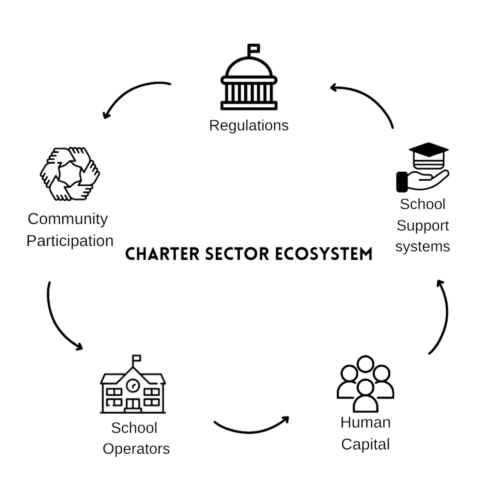
The Framework for Excellence: A Five-Pillar Approach
For policymakers, authorizers, and philanthropists, a charter school is not an isolated entity; it is a public service that requires a high-functioning support system to thrive.
- The Foundation: Regulatory Environment
In the charter sector, smart regulation is the “soil” in which quality grows.
- Strong Charter Laws: Quality begins with legislation that provides schools the flexibility to innovate while maintaining a high bar for entry.
- Professional Authorizing: Authorizers act as the primary stewards of quality. By upholding the “autonomy for accountability” bargain, they ensure that only high-performing schools remain in the ecosystem.
- The Feedback Loop: Independent researchers, advocacy groups, and an informed media provide the transparency and data necessary for the public to hold the system accountable.
- The Heart of the Movement: Diverse School Operators
Our sector’s strength lies in its ability to meet the unique needs of every student through a variety of educational models.
- Innovation and Niche Models: We are seeing a move beyond “one-size-fits-all” education, with public charter schools specializing in STEM, Classical education, Montessori, and specialized programs for students with autism.
- Responsible Replication: While independent, community-led schools are the backbone of our movement, high-performing Charter Management Organizations (CMOs) allow proven models to be replicated across state lines, bringing quality to more families.
- The Talent Pipeline: Human Capital
A school is only as effective as the professionals within it. We are professionalizing the “charter career path” to ensure a steady stream of talent.
- Entrepreneurial Leadership: We are cultivating a new generation of school leaders who are as adept at organizational management as they are at instructional leadership.
- Leadership Accelerators: Organizations like Teach For America and New Leaders act as vital pipelines, funneling high-potential educators and administrators into the sector.
- Operational Experts: We are increasingly recruiting professionals from finance, technology, and data management to handle “back-office” operations, allowing educators to remain focused on the classroom.
- The Demand Side: Community Participation and Empowerment
The American public has already signaled a massive demand for our schools: almost 4 million students are currently enrolled in public charter schools, with hundreds of thousands more on waitlists. However, “choice” is only meaningful if it is accessible. We must prioritize Customer Empowerment through:
- Unified enrollment systems that simplify the application process.
- Robust parent-information platforms that provide clear data on school performance.
- Community-led governance that gives families a seat at the table.
- Specialized Support Systems
As our sector scales, schools need access to the specialized services once provided by large district central offices. A thriving secondary market of support now includes:
- Academic programming and support for various teaching methods and a variety of students
- Specialized recruiting firms for teachers and board members.
- Third-party accounting, facility planning, and financing teams.
- Strategic philanthropy that provides the “seed capital” necessary to launch innovative new models.
Why the Ecosystem Matters
By mapping this ecosystem, we can identify “gaps in the system.” A city may have a strong charter law (Regulation) but lack a leadership pipeline (Human Capital). Another may have great schools (Operators) but lack the enrollment tools (Participation) to ensure equitable access.
By visualizing the sector as a full ecosystem, stakeholders can:
- Direct Strategic Capital: Philanthropists can fund the “missing links” in their specific regions.
- Mitigate Risk: Investors and authorizers can more accurately measure the health and viability of a school before it opens.
- Drive Global Reform: The “Charter Model” is now a global blueprint for how public-private partnerships can drive massive social impact in education.
A Vision for the Future
If we get this ecosystem right, we are doing more than just improving schools; we are creating a permanent, choice-driven engine for social mobility.
Our goal is to build a system where a child’s future is never determined by a lottery ball, and where a school’s success never depends on a “superhero.” By building a robust, sustainable ecosystem, we can ensure that high-quality public education is a reality for every student, today and for generations to come.
Let’s build the ecosystem together.
No Comments